
From ingredient handling to packing, a well-matched process helps producers deliver consistent colour, crunch and cluster size.
Whether granola is made in small batches or on a continuous industrial line, equipment selection starts with the recipe, required throughput and finished product. Accurate weighing of ingredients, gentle blending, even forming and controlled baking and cooling all contribute to consistent results. The right solution brings these stages together around the producer’s available space, labour, cleaning requirements and future plans.
Planning commercial granola production – recipes and capacity
The balance of oats, nuts, seeds and liquid binders influences how the mixture behaves during processing. The desired cluster size and any fruit, chocolate or other inclusions also shape the equipment required after baking.
Capacity should be considered alongside production frequency. Smaller batches and frequent recipe changes may be better supported by flexible, stand-alone equipment, while longer runs can justify an integrated line. The aim is to increase output while preserving the product’s colour, texture and character.
Explore EPP’s industrial bakery equipment to discuss individual process stages or a complete production line.
Granola ingredient handling, weighing and dosing
Granola typically combines dry ingredients, such as rolled oats, nuts and seeds, with liquid binders including honey, syrups and oils. How these materials are received and stored depends on production volume.
Smaller operations may handle dry ingredients in bags and liquids in buckets. At higher throughputs, intermediate bulk containers, on-site silos and bulk liquid tanks can support larger deliveries and automated handling.
Accurate weighing keeps the recipe in balance. Automated dosing can help maintain consistent proportions of dry ingredients and liquid binders as output increases, while ingredients intended for addition after baking should be accounted for separately.
Discover EPP’s ingredient reception, storage and dispensing systems for controlled storage and precise weighing of dry and liquid ingredients.
Mixing granola – gentle blending and even binder distribution
Mixing needs to distribute the ingredients evenly without damaging the oats, nuts and seeds. Blender design is therefore important, the action must be thorough enough to create a uniform mix, but gentle enough to preserve the ingredients’ structure.
The binder ingredients are normally premixed and heated to form a consistent liquid before being added to the dry blend. Even coating helps achieve consistent binding and texture throughout the batch.
Discharge is equally important, as once the binder has been added, the mixture becomes sticky and more difficult to handle. The blender should empty effectively and transfer the batch to the forming stage without unnecessary manual intervention.
See how mixing and automated unloading fit into EPP’s integrated granola production solution, and discuss the blending requirements of your recipe with the team.
Granola forming – controlling layer thickness and density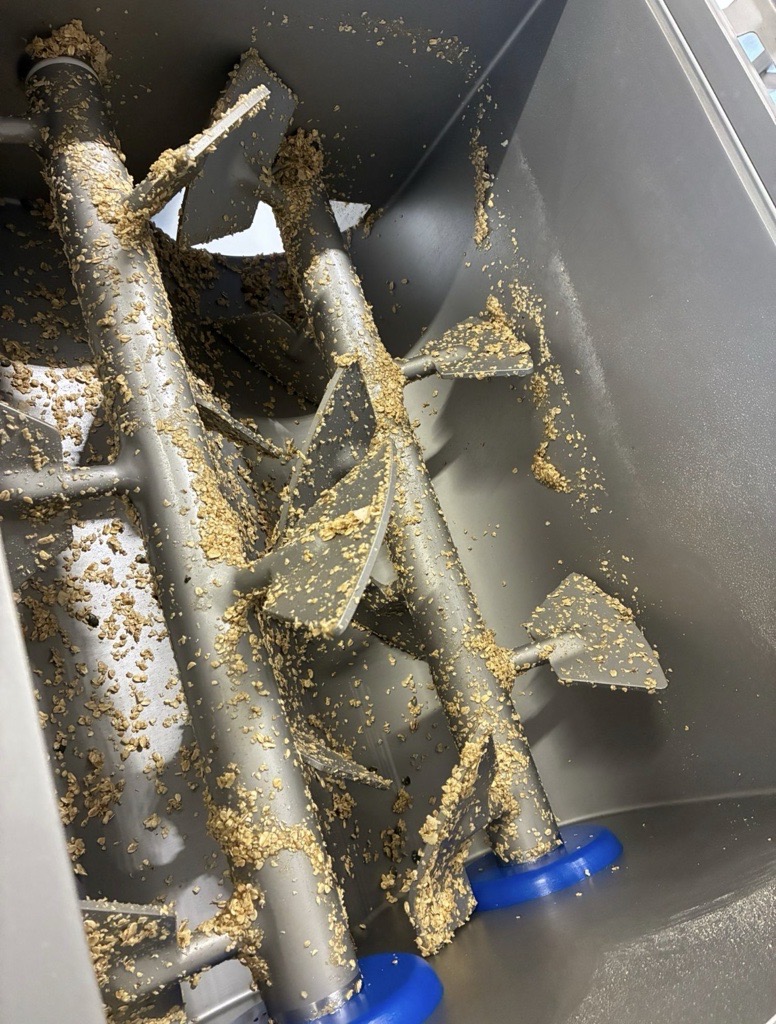
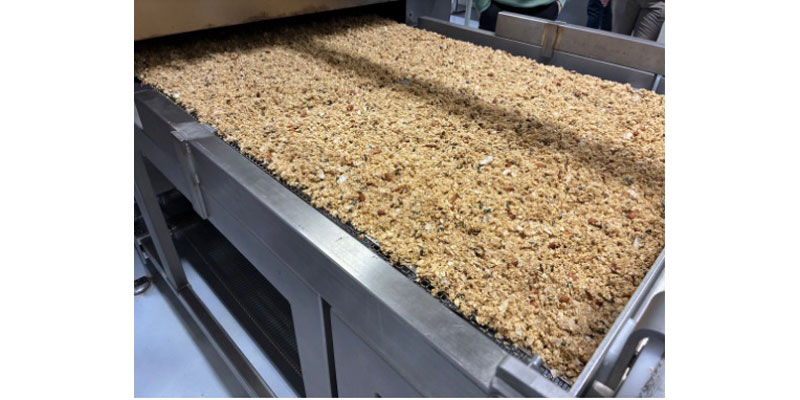
Before baking, the mixture must be formed into a layer of consistent thickness and density. Thin areas bake more quickly than thick sections, while a denser sheet requires longer baking. An uneven layer can therefore lead to differences in colour and texture across the finished product.
In smaller operations, the mixture is deposited into trays and compressed into an even layer. At industrial scale, each mixed batch feeds a hopper supplying a continuous forming system, which spreads the product onto the oven conveyor.
Feed rolls, moving rakes, gauging gaps, side guides and compression rollers can be used to establish the required layer. The forming system and oven must work together to maintain an even feed at the planned production rate.
Explore EPP’s industrial equipment portfolio and discuss a forming system matched to your granola recipe and oven.
Granola baking equipment – batch ovens and continuous systems
Baking develops the granola’s colour, flavour and texture. Heat must reach the grains and binder evenly, without burning the surface or leaving the centre insufficiently baked. The recipe, layer thickness and desired finish all influence the baking conditions required.
For smaller batches, trays can be baked in convection or rack ovens. At higher throughputs, a continuous tunnel oven carries the product through a controlled baking process. Oven selection should consider heat transfer, airflow, temperature control and the conveyor surface, rather than capacity alone.
EPP supplies SENIUS steel-belt impingement ovens for granola production, with controlled heat transfer and airflow to support uniform baking. The oven should be specified around the product and integrated with the forming and cooling stages.
Compare EPP’s rack ovens and tunnel oven solutions to discuss the right baking system for your output and product requirements.
Cooling granola for consistent texture and crunch
Cooling is an active part of granola production. Retained heat continues to affect the product after it leaves the oven, so rapid, controlled cooling is needed to set the binder and establish the crisp texture.
Cooling in trays can be more difficult because the metal retains heat. Forced-air cooling can help reduce the temperature, while continuous lines can incorporate a dedicated cooling stage matched to the oven output.
For steel-band systems, air-jet cooling and water cooling applied to the underside of the belt can accelerate heat removal. Cooling capacity and the product’s condition at discharge must be coordinated with the next stage, forming the clusters.
Discover EPP’s continuous cooling solutions and discuss the temperature control needed for your granola process.
Granola cluster formation and size control
In smaller operations, tipping the cooled product from trays breaks up the sheet, with further manual work often needed to achieve the desired piece size. Automated production uses a mechanical breaking or kibbling system to control cluster size.
Timing is critical, as breaking the sheet before it has cooled sufficiently, or after it has become too cold, can produce inconsistent results. An adjustable system allows cluster size to be matched to the finished product, supported by consistent conditions at the end of cooling.
Discuss cluster formation as part of EPP’s integrated processing equipment offering, so the system works in balance with baking and cooling.
Adding fruit, chocolate and other granola inclusions
Dried fruit, coconut, freeze-dried ingredients or chocolate may be added after the granola has been baked, cooled and broken into clusters. These additions can be introduced through a controlled feed onto the conveyor or by batch mixing.
The chosen method needs to distribute inclusions evenly without unnecessarily breaking the clusters. Accurate dosing is particularly important where ingredients are high-value or prominent in the product description, helping maintain the intended recipe in the finished pack.
See EPP’s depositing and decorating systems, including dry ingredient application options, and discuss a dosing arrangement suited to your ingredients and granola clusters.
Granola weighing and packaging equipment
At smaller volumes, preformed bags or pouches may be filled manually. As output increases, this becomes labour-intensive and makes consistent pack weights more difficult to maintain.
Automated weighing, including multi-head systems, can help control fill weights and reduce product giveaway. The equipment must accommodate the cluster size, inclusions and chosen pack format, whether feeding a form-fill-seal machine or filling preformed pouches. To avoid bottlenecks, size the packing equipment to handle more than the production line’s maximum output.
View EPP’s bagging and packing solutions and discuss the weighing, packaging and line-integration requirements of your product.
Bringing your granola production line together with EPP
A successful granola line depends on every stage working together. Accurate weighing supports consistent blending, an even product layer supports uniform baking and controlled cooling prepares the granola for cluster formation and packing.
European Process Plant Ltd (EPP) works with food manufacturers across the UK and Ireland to understand their products, production requirements and available space before recommending equipment. Working with its manufacturing partners, EPP can support equipment selection, trials and integration, whether the requirement is a stand-alone machine or a complete line.
Browse EPP’s equipment range and speak to the team about a granola production solution built around consistent quality, practical operation and future capacity.