
From small batches to automated lines, EPP explores how to match equipment to your product, process and plans for growth.
Sausage rolls remain a bakery staple across the UK and Ireland, from the high street counter to the food-to-go chiller and the frozen bake-off cabinet. Producing them consistently at scale requires control of pastry, filling, forming, baking and packing. The right equipment depends on the product, throughput, available space, labour, cleaning requirements and future plans.
Determine the product and capacity
The first decision is the product itself. Will it be a traditional pork sausage roll, a vegetarian or vegan alternative, or a premium product with cheese, chutney or added seasoning? Each filling behaves differently during mixing and forming.
The pastry matters just as much. Most sausage rolls use a flaky pastry, either a fully laminated puff pastry or one made using the ‘Scotch’ or ‘rough puff’ method, where chunks of fat are added at the final stage of mixing. This version of puff pastry provides the characteristic flakes and a more robust pastry whereas the fully laminated process which requires a more controlled handling of the pasty gives more height and more delicate thin even layers. The pastry type will shape how it’s mixed, rested and sheeted.
The finished format also determines the equipment required. Party bites, standard and jumbo rolls all need different cut lengths, while the route to market decides whether products are baked and cooled, frozen raw for bake-off, or baked and then frozen.
Capacity should be considered alongside production frequency. Occasional batches or a wide recipe range may be better supported by flexible stand-alone equipment, while long production runs can justify an integrated line. Production falls into three categories:
- Small batch: pastry brake, manual forming and cutting, and batch baking in a convection, deck or rack oven
- Semi-automated: machine sheeting with a filling extruder or depositor, plus manual cutting, panning or finishing
- Fully automated: an integrated process from pastry sheeting and filling extrusion through to folding, cutting, finishing and baking or freezing
Explore EPP’s industrial bakery equipment for options spanning small-batch, semi-automated and fully integrated production.
Mix and sheet the pastry
Flaky pastry relies on keeping the dough and fat in separate layers. If the fat is worked into the dough during mixing or sheeting, those layers are lost and the bake will be dense rather than light and crisp. Dough temperature, fat temperature and mixing time all need careful control.
For rough puff pastry, the fat is added at the end of mixing, so it stays in distinct pieces. The choice of mixer and mixing tool is critical, and larger mixers can remove a common bottleneck when scaling up. EPP works with VMI, a leading manufacturer of mixers and automatic mixing systems, to specify the right mixer and tooling for each recipe.
Discover EPP’s industrial mixing solutions, including spiral and automated systems, dough-temperature control, bowl tips and feed systems.
The pastry is then sheeted, folded and reduced to the required thickness. It needs to be deep enough to give a crisp, flaky bite, but thin enough not to overwhelm the filling. Resting between stages lets the dough relax, which helps limit shrinkage after cutting and baking. Small producers may use a tabletop or floor-standing pastry brake, while larger plants use continuous sheeting lines with gentle, gradual reduction stages.
View EPP’s bakery equipment, from tabletop pastry brakes to industrial sheeting lines.
Prepare the filling
A great filling needs a fine balance of flavours and a structure that holds together when cut. The filling must be even and well blended without damaging the ingredients, as overworking can make the filling dense and affect the overall texture.
Temperature control matters for both quality and food safety. Keeping the filling cool helps it hold its shape during forming and stops it softening the pastry it’s wrapped in. Batch size should match the pace of production, so the filling is used while its condition is right.
Accurate weighing keeps the recipe consistent as volumes grow, and at higher throughputs automated ingredient handling and dosing can reduce manual work. Once mixed, the filling must also be stable enough to form the core around which the pastry is wrapped.
Discover EPP’s ingredient reception, storage and dispensing systems and talk to the team about mixers and mixing tools suited to your filling.
Form, seal and cut
On an automated line, the filling is extruded or deposited as a continuous tube onto the moving pastry sheet. The extruder or depositor controls the diameter and weight of the filling, so accuracy here sets the pastry-to-filling ratio of every roll.
The pastry is then folded around the filling and the seam sealed, typically with water or egg wash, so it doesn’t open during baking. A clean, consistent seam also gives the finished roll a neat appearance.
The continuous roll is cut to length with a guillotine, set for party bites, standard or jumbo products. An egg or plant-based glaze is usually applied for colour and shine, with optional scoring, seeds or toppings for decoration. The rolls then move onto trays or a conveyor, ready to bake or freeze. Interchangeable cutting and depositing settings help reduce changeover time where several products share one line.
See EPP’s depositing, injecting and decorating lines for glazing, seeding and topping solutions.
Control the bake
Baking delivers the golden colour and crisp, flaky texture that defines a good sausage roll. The pastry layers need enough heat to lift and set, while the filling must be fully cooked through without the base turning soggy or the top over-colouring.
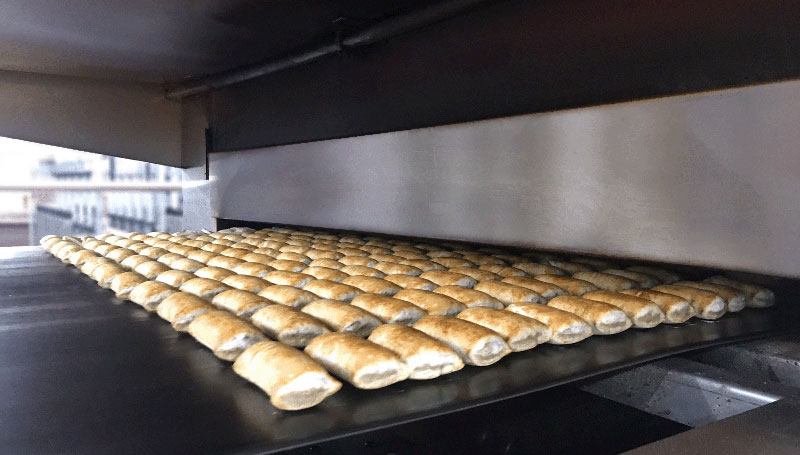
The science of the bake stays the same, but the method depends on volume. Small quantities can be baked in a convection or deck oven, while energy-efficient MIWE rack ovens suit larger batch baking. For dedicated production lines, a continuous tunnel oven carries the product through on a steel band, giving consistent results and minimising handling. EPP supplies SENIUS tunnel ovens, specified around the product and integrated with the forming and cooling stages.
Consistent colour is a useful process indicator, but the core temperature of the filling must always be verified. Compare EPP’s rack ovens and tunnel ovens to find the right baking system for your output.
Cooling, freezing and packaging
Sausage rolls can be supplied in several formats, depending on the market. They can be frozen raw for bake-off in store or foodservice, baked, cooled and packed for chilled sale, or baked and then frozen.
For baked products, reaching the correct core temperature before packaging is essential. Packed too warm, condensation can form inside the pack, softening the pastry and affecting shelf life. Vulganus spiral systems provide controlled cooling with consistent conditions year-round, whatever the factory temperature, and spiral freezing allows high volumes to be frozen within a compact footprint.
Packaging can connect directly to the line where sufficient cooling and accumulation are allowed between stages. Explore EPP’s continuous proofers, coolers and freezers and its flow wrapping, bagging and packing solutions.
Cleaning, food safety and operator training
Raw meat, pastry, fat, flour and glazes each create different cleaning demands. Accessible, washable equipment and a routine covering between-batch, end-of-shift and deeper cleans will help protect product quality and equipment life.
Food safety needs to be designed into the layout. Raw filling should be kept separate from baked products, with a clear flow from raw to cooked areas, and allergen controls are important where egg, seeds, cheese or other ingredients are used. Hygienic stainless-steel construction and easy access for cleaning support these requirements.
Automation reduces manual handling, but operators still need to understand pastry condition, filling consistency, machine settings and oven control. Effective training helps maintain consistent weight, shape, colour and finish throughout production.
Balancing today’s output with tomorrow’s growth
A sausage roll line should meet today’s needs without limiting future opportunities. Capacity is determined by the slowest stage, so pastry production, filling, forming, baking and packing must all be balanced around the desired throughput rate. Allowing space for extra sheeting capacity, a larger oven or a freezing stage can make it easier to increase throughput or expand the product range later.
Equipment built around your process
The right solution begins with a clear understanding of the product and how it will be made. EPP works with bakeries and food manufacturers across the UK and Ireland to consider recipes, volumes, labour, changeovers, available space and future capacity before recommending stand-alone equipment or a complete line. Explore EPP’s bakery equipment or speak to the team at sales@eppltd.co.uk about a process built around consistent quality, efficient production and practical growth.